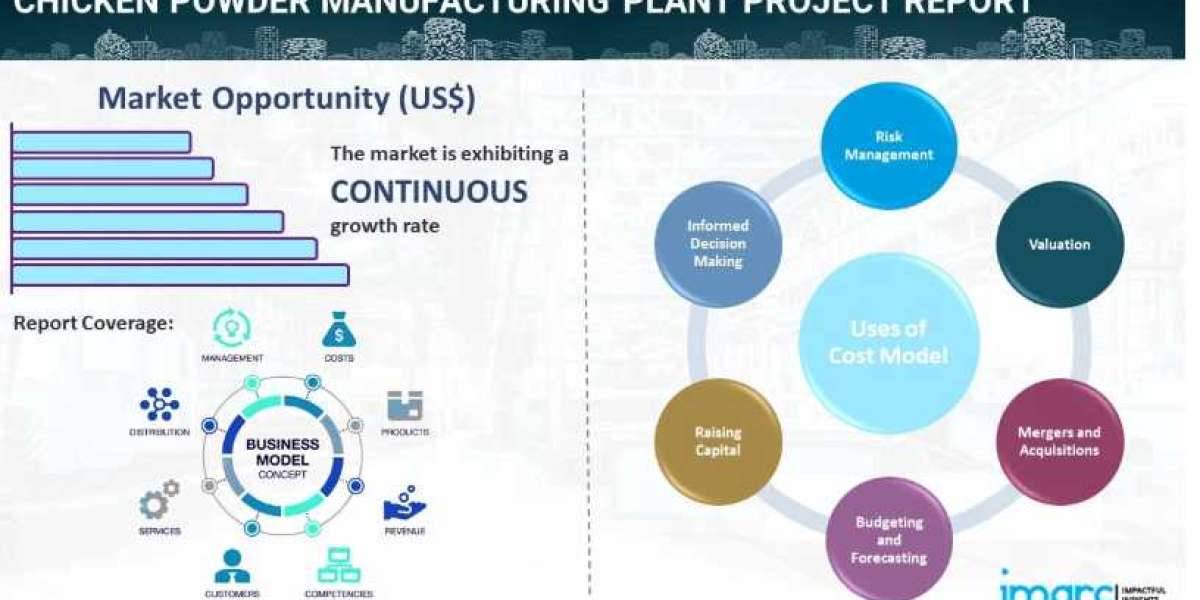
IMARC Group’s latest report on Chicken Powder Manufacturing Plant cost Setup in the USA provides a detailed roadmap for entrepreneurs, investors, and stakeholders planning to establish or expand chicken powder production capacity. The study delivers a comprehensive assessment of the manufacturing process, plant layout, machinery requirements, project economics, and essential considerations tailored to the U.S. industrial landscape.
With the growing demand for protein-rich food products and convenience foods in the U.S., this report outlines how adopting modern processing technologies and optimized plant design can enhance cost-efficiency, food safety compliance, and long-term competitiveness. It serves as a practical framework for decision-makers to navigate feasibility analysis, funding evaluation, and regulatory alignment efficiently.
Report Summary
This report offers a complete blueprint for setting up a chicken powder manufacturing plant in the United States. It covers all aspects of project development—from raw material sourcing and site selection to capital cost estimation, process design, and financial modeling.
The study supports investors and operators in assessing project viability, evaluating potential risks, and implementing strategies for market entry. It also integrates food safety and quality standards in line with U.S. regulations, making it a valuable resource for both greenfield and brownfield projects.
Key Features
- Process Flow and Manufacturing Steps: Step-by-step breakdown of chicken powder production, including raw material preparation, cooking, drying, and grinding processes.
- Plant Layout and Infrastructure: Essential design considerations for safety, space optimization, and efficient workflow.
- Machinery and Equipment: Detailed overview of equipment specifications, configurations, and supplier guidance (available on request).
- Raw Materials and Utilities: Raw material requirements, sourcing strategy, and energy, water, and utility needs.
- Project Economics: Comprehensive capital and operating cost structure with profit modeling and sensitivity analysis.
- Quality Assurance: Standards and testing protocols for product safety, nutritional content, and shelf life.
- Financial Evaluation: Return on investment (ROI), payback period, liquidity, and risk metrics.
- Market Outlook: Demand dynamics, industry segmentation, and downstream applications across sectors.
Request the Sample Report:
https://www.imarcgroup.com/chicken-powder-manufacturing-plant-project-report/requestsample
Entrepreneurs and organizations planning to establish or expand chicken powder production capacity in the USA can request a sample report and schedule a consultation with IMARC Group’s food processing analysts. The firm offers tailored feasibility studies covering local regulatory compliance, utility cost structure, logistics optimization, and project financial modeling.
Chicken Powder Demand in the USA
Chicken powder is a critical ingredient in the U.S. food industry, supporting a wide range of sectors including:
- Food Processing: Used as a flavoring agent and protein supplement in ready-to-eat meals and snacks.
- Seasoning and Sauces: Integral in the production of bouillons, soups, and sauces.
- Pet Food: Increasingly used in high-quality pet food formulations.
- Health Supplements: Gaining popularity in protein powders and dietary supplements.
Steady industrial demand, along with rising interest in convenient and nutritious food products, presents significant opportunities for local manufacturers to strengthen domestic supply and reduce import dependency. The report emphasizes how plant operators in the U.S. can leverage the country’s strong infrastructure, skilled labor, and supportive policy environment for competitive advantage.
Key Considerations for Setting Up a Plant in the USA
- Site and Utilities: Access to high-quality raw materials, stable power grid, reliable water supply, and efficient logistics networks.
- Regulatory Compliance: Adherence to U.S. food safety standards, FDA guidelines, and USDA regulations.
- Technology Selection: Preference for energy-efficient processing systems to minimize energy consumption and maximize yield.
- Safety Standards: Implementation of robust food safety protocols and hygiene standards.
- Supply Chain Integration: Proximity to chicken suppliers and distribution networks to ensure off-take stability.
Project Economics Overview
The report provides a detailed financial framework for establishing a fully integrated chicken powder manufacturing plant in the U.S.
- Capital Expenditure (CAPEX): Includes land acquisition, civil works, machinery procurement, utilities installation, and storage infrastructure.
- Operating Expenditure (OPEX): Covers raw materials, energy, labor, packaging, logistics, maintenance, and compliance costs.
- Revenue Streams: Primary revenue from chicken powder production, with additional income from by-products such as rendered fat and broth concentrates.
- Sensitivity Factors: Raw material costs, processing efficiency, capacity utilization, and market pricing dynamics.
This analysis enables entrepreneurs and financial planners to evaluate cost structures and determine project profitability with confidence.
Analyst Insights
According to IMARC Group’s food processing team:
“The U.S. market provides an ideal environment for next-generation chicken powder plants due to its mature food processing infrastructure and focus on health-oriented products. Integrating sustainable sourcing and innovative processing technologies can significantly enhance project viability. Compliance with evolving food safety standards is now defining success in food manufacturing investment strategies.”
What’s Included in the Detailed Project Report (DPR)
- Process Design Package (PDP): Block flow diagram (BFD) and process flow diagram (PFD) with material and energy balances.
- Equipment Sizing and List: Detailed specifications for cooking, drying, and grinding equipment.
- CAPEX and OPEX Models: Breakdown of major cost components and expenditure profiles.
- Financial Model: Ten-year financial projections including PL, cash flow, IRR, NPV, and sensitivity analysis.
- Regulatory and Environmental Review: Overview of U.S. regulatory requirements and food safety compliance frameworks.
- Implementation Roadmap: Project timeline, EPC contracting strategies, vendor longlist, and commissioning milestones.
Why Establish a Chicken Powder Plant in the USA
- Stable Demand Base: Continuous consumption across diversified food sectors.
- Infrastructure Advantage: World-class logistics, ports, and energy networks for efficient operations.
- Innovation Ecosystem: Opportunities for RD and process automation through advanced technologies.
- Sustainability Focus: Strong alignment with national food safety and health objectives.
- Export Potential: Access to North American and Latin American markets under regional trade frameworks.
About IMARC Group
IMARC Group is a leading global market research and consulting firm specializing in food processing, chemicals, energy, industrials, and manufacturing. Its food processing practice combines deep techno-economic modeling with practical engineering support—helping investors and operators transition from concept to commissioning.
From feasibility studies and cost estimation to vendor selection and operational excellence, IMARC provides data-driven insights and execution support across every stage of project development.
Contact Us
IMARC Group
134 N 4th St, Brooklyn, NY 11249, USA
Email: sales@imarcgroup.com
Tel: (+1) 201-971-6302